Modelling with ADHD, OCD and a Busy Brain
Honest pitfalls and practical bench strategies for modellers living with ADHD, OCD, anxiety and more.
Sprue Wranglers · · 6 min read
Top tips
Keep two or three builds at different stages so switching is a plan, not a failure.
Decide what 'done' looks like for each stage before you start it.
Judge your work from arm's length, not under a magnifier.
Set a timer to remind yourself to stretch, eat and sleep.
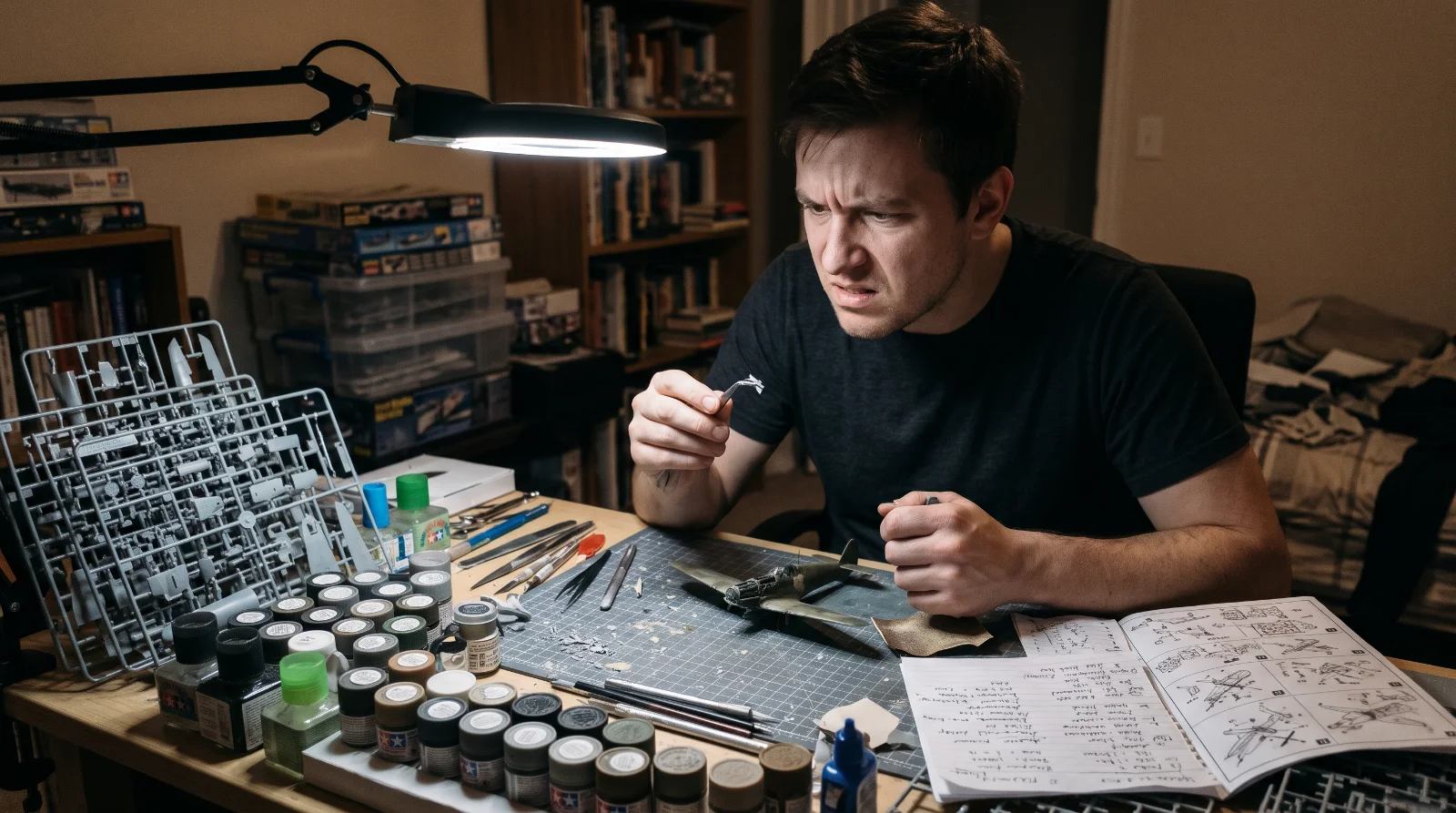
Plenty of us came to this hobby — or came back to it — partly because it quiets the noise. A sprue, a pair of cutters and a couple of hours at the bench can be the calmest part of the week. But if you live with ADHD, OCD, anxiety, autism or similar, you'll also know the hobby can turn on you: the unfinished kits, the part you sanded fifteen times, the evening lost to a single decal. This article is for you. It isn't medical advice, and nobody here is going to "fix" you. It's a collection of honest observations and practical bench strategies from modellers who've been there.
Why modelling can help
There's a growing body of writing — from occupational therapists, researchers and modelling clubs — describing scale modelling as a genuinely therapeutic, non-clinical activity. A 2025 study of miniature painters found participants regularly reached a "flow" state they described as meditative and good for their mental health. Occupational science researchers at Sheffield Hallam have written about model building as a lifelong occupation that supports wellbeing and identity.
The reasons make sense:
- Structure. A kit has a clear sequence, numbered parts and a defined end point.
- Visible progress. You can see what you did tonight. That matters when the rest of life feels shapeless.
- Hands-on focus. Fine motor work pulls attention into the present and can crowd out intrusive or racing thoughts.
- Control. On the bench, you decide the pace, the standard and the outcome.
The catch is that every one of those strengths has a shadow side.
ADHD at the bench
The common pitfalls
- The stash. New kits deliver a lovely hit of novelty. Many ADHD modellers own far more kits than they'll ever build — and the pile itself can become a source of guilt.
- The "shelf of doom". Interest is intense, then suddenly gone. Half-built models stack up, usually stalled at a boring stage like seam filling or masking.
- Skipping steps. Reading instructions properly is hard when you want to get on. Result: parts glued on the wrong side, or a cockpit sealed in before it's painted.
- Hyperfocus. Looking up at 2am with cold tea, a sore back and no dinner. Great for progress, rough on everything else.
- Losing things. Tiny parts, tools put down "just there", the carpet monster.
Strategies that help
- Have more than one build on the go — on purpose. Instead of fighting the urge to switch, plan for it. Keep two or three builds at different stages, so when filling and sanding bores you, you can paint something else. Switching becomes a tool, not a failure.
- Break the build into tiny wins. "Build the cockpit" is vague. "Clean up parts C4–C9" is a 15-minute job you can actually start. Write the next tiny step on a sticky note on the box before you stop.
- Highlight the instructions. Tick off each step as you finish it, and use a highlighter to mark which steps apply to your version. Some modellers photograph each page and keep it on a tablet so they can zoom in.
- Turn the model to match the diagram. If the instructions show the aircraft upside down, physically hold it that way. Dry-fit before glue, every time.
- Use timers. A kitchen timer or phone alarm every 45–60 minutes is a gentle tap on the shoulder to stretch, drink, eat or go to bed.
- Contain the parts. Sprue racks, labelled pots, a magnetic tray, a light-coloured bench mat and a cutting tray with raised edges all reduce the "where did it go?" drama.
- A one-in, one-out rule for the stash. Or a wishlist where new kits sit for a month before you buy. Often the urge passes on its own.
- Snap-fit and quick builds count. Modern snap kits and simple 1/72 subjects are finishable in a weekend. Finishing things builds confidence for the bigger ones.
OCD, perfectionism and the endless sand
The common pitfalls
- "Not quite right." Re-sanding, re-priming or stripping paint over and over because something feels wrong, even when nobody else could see it.
- Fear of starting. Not opening a kit because you might ruin it. The box art stays perfect; the plastic stays on the sprue.
- Accuracy spirals. Hours of research into the exact shade of a specific airframe on a specific day, until the build feels like an exam.
- Rituals around the bench. Needing the workspace arranged a certain way before you can begin, or checking and rechecking tools and paints.
- Comparison online. Forums and social media are full of competition-level work. It's easy to treat that as the minimum standard.
Strategies that help
- Decide the "done" line in advance. Before starting a stage, set the standard: "seams filled to where I can't feel them with a fingernail." When you meet it, move on — even if the itch says otherwise.
- Use the three-foot rule. Judge your model from arm's length or display distance, not under a magnifier. That's how everyone else will see it.
- Build a "practice" kit. A cheap, old-tooling kit you're explicitly allowed to wreck takes the pressure off and is a great place to try new techniques.
- Limit redos. Give yourself a set number of attempts at a tricky bit (say, two), then accept the best one. You can always rebuild the same subject later.
- Remember: it's a model, not a museum piece. "Good enough for my shelf" is a perfectly valid goal. Real aircraft were dirty, chipped and slightly mismatched anyway.
- Curate your feed. Follow builders who show their mistakes and works-in-progress, not just glossy finished pieces.
- Notice when it stops being fun. If bench time is leaving you more anxious, not less, that's a signal — and a good reason to talk it through with your GP or therapist. Exposure and response prevention (ERP), the main evidence-based therapy for OCD, can be practised gently at the bench with professional guidance.
Anxiety, autism and sensory overload
Some modellers find the sensory side of the hobby hard: the smell of solvents, bright lighting, the hiss of an airbrush compressor, the texture of sanding. Others love the predictability and detail but struggle with clubs, shows and busy model shops.
- Go low-odour. Acrylic paints, water-based putties and extra-thin glues with good ventilation are gentler than enamels and lacquers. Always ventilate anyway.
- Control the light. A daylight lamp with adjustable brightness reduces eye strain and glare.
- Quiet kit. Compressors with tanks run less often; ear defenders or headphones help with any noise.
- Online first. Friendly forums and build groups let you share at your own pace before you try a club night. Many clubs are welcoming if you tell them in advance you'd like a quiet corner.
Looking after yourself overall
- Keep sessions short and regular rather than rare marathons.
- Tidy the bench at the end, not the start — so the next session begins with a clean, inviting space instead of a barrier.
- Keep a build log. Photos or a notebook help you see progress on days your brain insists you've done nothing.
- Be kind about the unfinished ones. A stalled kit isn't a moral failure. Mothball it, raid it for spares, or give it away. Some modellers simply pack everything up for a while — and that's fine too.
- Safety still matters. When focus wavers, knives slip. Cut away from yourself, use a fresh blade, and stop when you're tired.
When to seek support
If the hobby has become a source of distress — compulsions you can't stop, spending you can't control, or a low mood where nothing holds your interest — please talk to someone. In the UK, your GP is the starting point, and charities such as OCD-UK, ADHD UK and Mind have excellent resources. If you're in crisis, Samaritans are available 24/7 on 116 123.
The bottom line
Your brain works the way it works. The bench is one of the few places where you get to set every rule — so set rules that suit you. Build three kits at once. Stop at "good enough". Finish a snap kit in an afternoon just because. The only right way to enjoy this hobby is the way that leaves you feeling better than when you sat down.